Posts

Prompt #2 The Roles We Play

  Prompt #2: The Roles We Play   Coming from an Indian household with my parents being immigrants, there has always been this subtle pressure of needing to succeed in every avenue of life. It definitely isn’t like this for all first generation Indian high schoolers, but the pressure to maintain a high GPA, do tons of extracurriculars, get into a hyper-selective college, find a day job with a prestigious sounding title that would impress the people back home and make 6 figures until you aren’t able to function is never ending. This is the role many of us are expected to play at Troy High and it undoubtedly leads to constant comparisons and no room for uniqueness or personality. Even people that I know who have graduated years ago have told me that high school is definitely not the best place for your mental health.  My parents, like many others, worked insanely hard to get to America— having to enter a country where they aren’t looked at the same, where they don’t know the...
From Good Vibes to Genocide: The Origins of the Swastika

  We’ve all seen the symbol of the Swastika in the pages of ‘Maus’ in the past week. Whenever it showed up on a page, it denoted fear, power, and the telltale impact of genocide that followed the Nazis. But the real origins of the Swastika dates back about 6,000 years ago, the oldest sightings discovered in cave and rock paintings. In Sanskrit (a classical Indian language), ‘Swastika’ means well-being. Scholars have hypothesized that the symbol first originated in the Indian subcontinent and moved westward to Scandinavia, the Scottish Highlands, Finland, and other parts of Europe. Today, it is still used in a number of religions, such as Buddhism, Jainism, Zoroastrian faith, and many more. Greek currency, Native American healing rituals, Baroque architecture, and Iron Age artifacts all hold some trace of the Swastika. Generally, the swastika was regarded as a symbol of auspiciousness and good luck. So how did the meaning of this once innocent symbol change from prosperous to infamo...

Honey, I Shrunk the Jews!

Image
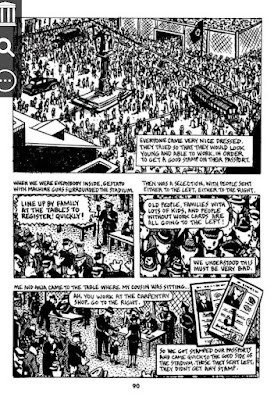
Through the use of perspective in page 83 of Maus, Spiegelman develops the argument that the Nazis stripped Jewish people of their individualism and viewed them as insignificant beings that were below them. The large panel at the top of the page depicts a scene where many Jews have all been rounded up so officers could verify papers and sort them,    and the panel seems to be zoomed out, at first glance to illustrate the sheer number of people present. But it also mirrors how people would view ants— tiny, uniform, and powerless. Being depicted as small itself is a sign of weakness, as in the movie ‘Honey, I Shrunk the Kids’. When the characters were small, they didn’t have any power of what was going on around them at all. They could be squashed, vacuumed, or eaten whole by a pet and they didn’t have anything to defend themselves. This mirrors how the Jews were depicted in the panel— defenseless. It also served as a reminder of how Nazis could so easily alter the course of a J...

Sweat Prompt #3

Image
Prompt #3  America has always held the honorary title of “the land of opportunity”. And whether it may not always be kind enough to fulfill this promise, it definitely has a place for you. Whether you’re an immigrants or you’ve been here for generations, there is bound to be a community for you somewhere within this melting pot of land. But every story don’t always get told. Sometimes they’re hidden by media chatter of who’s dating who in Hollywood, or who you should vote for, or what to wear and how to live and how to spend your minimum wage salary so that it benefits the economy and not you. But Lynn Nottage has made it her mission to sort through the junk and the TV static and find the stories of  real  people. Not the white collar business men who make 300K a year, the lower class. The people that make up  46%  of America. It may seem like the struggles of Olstead workers in Reading isn’t very widespread, but the truth is, this is how 46% of our country live...

‘I Too’ | Langston Hughes

Image
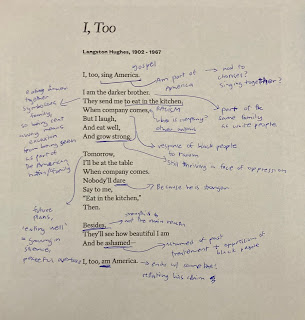
  Having a ‘seat at the table’ insinuates that you’re deserving of respect and trusted to be apart of important discussion. Having a ‘family dinner’ denotes a gathering where you eat good food with people you love, while celebrating nothing in particular except your togetherness. Langston Hughes uses both of these concepts metaphorically in his poem, ‘I, Too’, which centers around the exclusion of Black Americans from American society. The poem starts off by Hughes declaring that he ‘sings America’. I believe that this is a nod to choirs, and how they are sung with the voices of groups of people rather than singularly. Hughes is stating that he, too, is a part of the American nation. Afterwards, stating that he is the ‘darker brother’ asserts that he is still part of the same family as white people in America. The third line is where the metaphors come in— ‘being sent to eat in the kitchen means that black Americans are hidden from the ‘company’ (the world stage, other nations) and...

Where did Great Gatsby's Gryffindors Go?

Sorting various Great Gatsby characters into Hogwarts houses has made me realize that there's another underlying theme about the presence of shallowness that Fitzgerald presents to us through the majority of his character's personalities.  1. Tom - Evidenced from Tom's overall brutish personality, we all know that Tom Buchanan is the most arrogant, conceited, insulting character in The Great Gatsby. He had 0 moral convictions all throughout his affair with Myrtle (I'm not calling it a love affair because breaking another's nose certainly doesn't seem full of love), but when he had a sneaking suspicion that something was going on between Gatsby and Daisy, he started itching for a confrontation. He holds everyone around him to moral standards that he doesn't even bother with. He also hails from an upper class, wealthy family and takes pleasure in being part of social circles that are unattainable to others, like at Yale with Nick, which leads me to believe tha...

Roaring Love in the Roaring Twenties

The Jazz Age. An era of new, shiny things— flashy nightlife, extravagant parties, and the lively music of tipsy, outrageous youth. But aside from material elements, this era brought sexual liberation, redefinitions of age old gender roles, and the freedom to choose how you wanted to find love. However, to really understand how revolutionary this era was for romance, we have to go all the way back to the Victorian Era.  In the 1800s (back before dating was even a thing), men used to use calling cards during the ‘social season’ (spring and summer) to court young women as their wives. Men looking to court a woman would give their card of information to the butler, and line up in her house. Each would have some time to talk to her parents, have refreshments, and watch her play piano, sing, or display some other talent solely for the man’s entertainment. Marriage wasn’t just a relationship between two people at the time, but a family affair. The general age for a woman to enter the soci...